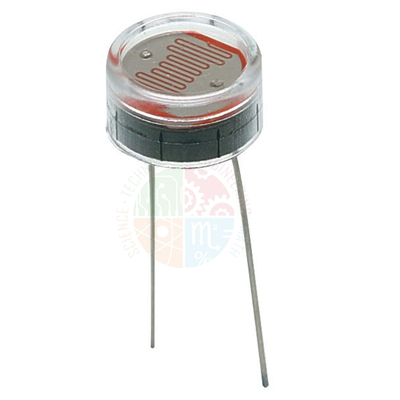
Quick Answer:The NORPS 12 LDR is a cadmium sulphide photoconductive cell with a spectral response similar to the human eye, housed in a robust plastic case with a clear end window. Its resistance falls from 1 MΩ in darkness as the light on it increases.
Last updated: 18 October 2026
Key Features
CdS photoconductive cell with an eye-like spectral response.
Moisture-resistant coating inside a robust plastic package with a clear end window.
Resistance reduces as the light falling on it increases.
Rated up to 250 V peak AC or DC and 250 mW.
Technical Specifications
Specification
Value
Cell type
Cadmium sulphide (CdS) photoconductive
Dark resistance
1 MΩ
Resistance at 1 ftc
5.4 kΩ min., 12.6 kΩ max.
Max. voltage
250 V peak AC or DC
Power dissipation
250 mW max.
Top dimensions (dia. x d)
14.35 x 7 mm
Pin length
9.53 mm
Operating temperature
–60 °C to +75 °C
How It Is Used
Because its response follows the human eye, the cell is a good sensor for experiments on light levels, for example plotting resistance against illumination or switching a circuit as the room darkens.
Frequently Asked Questions
What is the NORPS 12 LDR made of?
It is a cadmium sulphide (CdS) photoconductive cell, encapsulated in a moisture-resistant coating and enclosed in a plastic case with a clear end window.