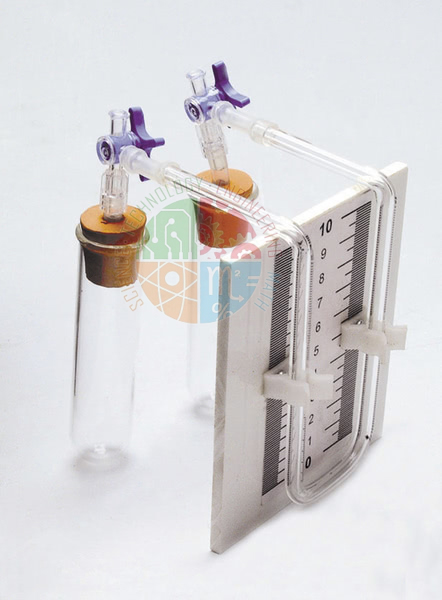
Quick Answer:The Respirometer is a compact unit for comparing how fast small organisms absorb or give off gases during respiration, built from two stoppered boiling tubes joined by three-way taps to the two limbs of a graduated manometer.
Last updated: 18 October 2026
Key Features
Two stoppered boiling tubes, each linked by a three-way tap to one limb of a graduated manometer.
Experimental tube holds the organisms and has a syringe for setting the manometer liquid level.
Second tube acts as a control thermo-barometer.
Wire baskets support the organisms.
Technical Specifications
Specification
Value
Chambers
Two stoppered boiling tubes
Connections
Three-way taps to each limb of the manometer
Manometer
Graduated
Set-up control
Syringe on the experimental tube
Included
Wire baskets for supporting organisms
How It Is Used
Small organisms are placed on a wire basket in the experimental tube, where the carbon dioxide they give off is absorbed by potassium hydroxide. The resulting change in gas volume moves the liquid in the manometer, while the second tube serves as the control thermo-barometer.
Frequently Asked Questions
How does the Respirometer measure respiration?
Carbon dioxide from the respiring organisms is absorbed by potassium hydroxide in the experimental chamber, and the change shows as a movement of the liquid level in the manometer tube.
What is the second tube of the Respirometer for?
It is a control thermo-barometer, set up alongside the tube that holds the organisms.