
Planck's Constant Determination Box
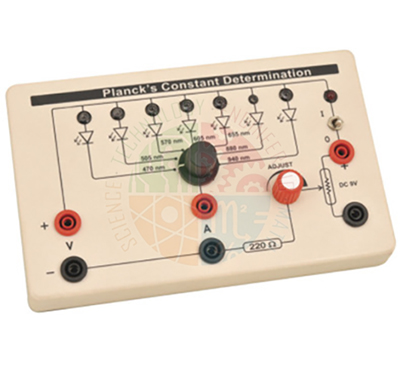
Product Code : JLI-PLE-10590
Quick Answer: The Planck’s Constant Determination Box finds an approximate value of Planck's constant from the voltage at which each of seven LEDs, from deep blue at 470 nm to near infrared at 940 nm, begins to emit light. It needs an external 9 V supply or battery and connecting leads.
Last updated: 18 October 2026
Key Features
- Seven LEDs mounted on the box, covering deep blue (470 nm) to near IR (940 nm).
- Sockets on the box for voltage and current measurements.
- Uses the elbow voltage in each LED's characteristic curve.
- Requires an external 9 V power source or 9 V battery, plus connecting leads.
Technical Specifications
| Specification | Value |
|---|---|
| Number of LEDs | Seven |
| Wavelength range | 470 nm (deep blue) – 940 nm (near IR) |
| Power required | External 9 V source or 9 V battery |
| Connections | Sockets for voltage and current measurement |
How It Is Used
Students raise the voltage across each LED in turn and note where it starts to glow. Plotting this energy input against the frequency of the emitted light gives a graph from which an approximate value of Planck's constant is deduced.
Frequently Asked Questions
What power does the Planck’s Constant Determination Box need?
An external 9 V power source or a 9 V battery is required, together with connecting leads.
How many LEDs does the Planck’s Constant Determination Box have?
Seven LEDs, ranging from deep blue at 470 nm to near infrared at 940 nm.
Related Physics Lab Equipment
See the full physics lab equipment range, or these related photoelectric and LED experiment items:
- Planck’s Constant Apparatus
- LED Characteristics Apparatus
- Energy Band Gap Apparatus
- Digital Multimeter
For a quotation on the Planck's Constant Determination Box, contact JLab India on +91-8569909696.

